
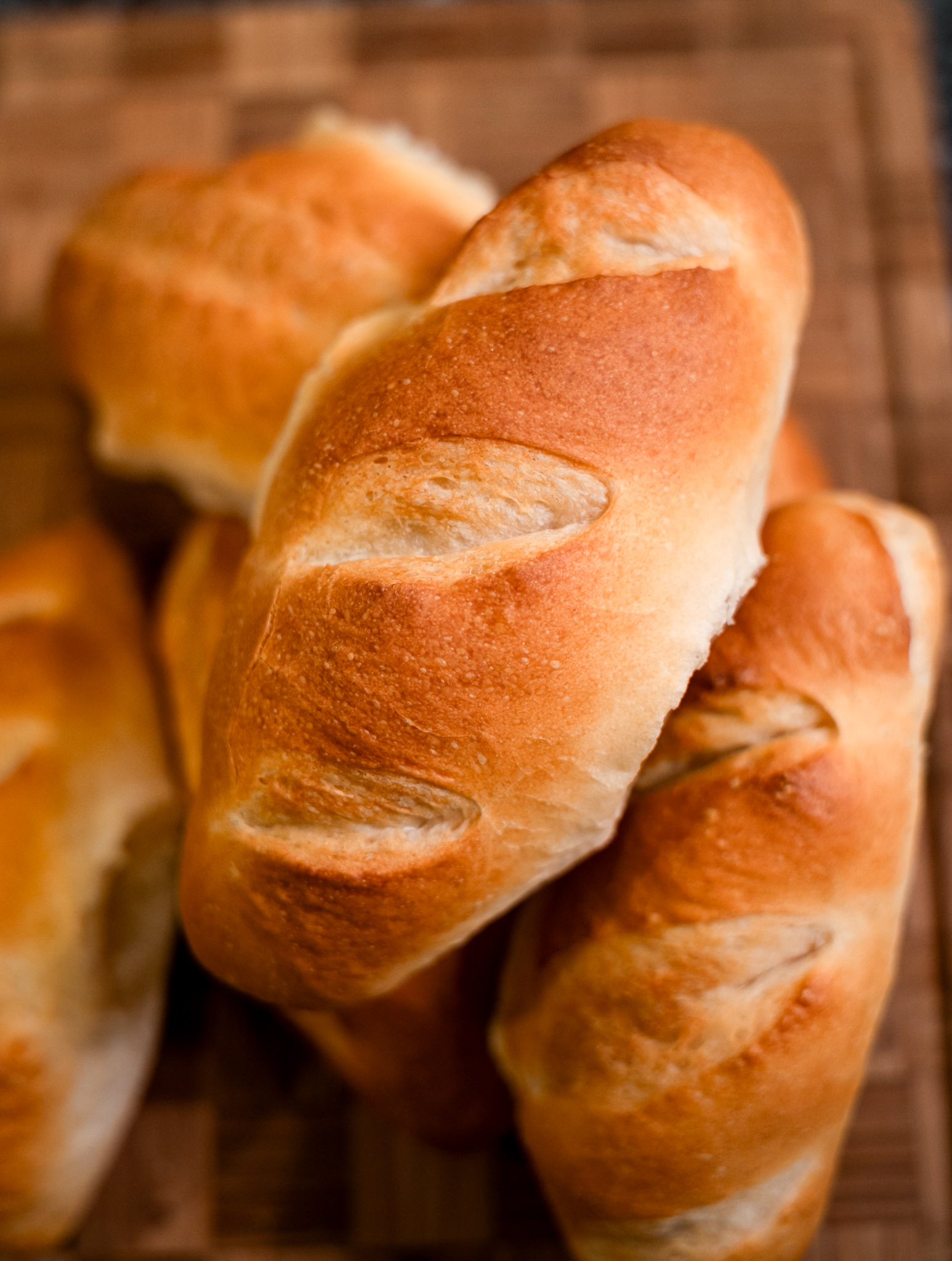
Welcome to my kitchen! Where I attempt to learn how to make the culinary dishes from my native culture. Today, we are starting with the famous Vietnamese baguette or Bahn Mi.
For me, Vietnamese baguettes aren’t just bread. They’re a symbol of the childhood I didn’t fully experience. Bahn mi’s were a special treat rather than a quick bite to eat for my family. But they are an essential staple in Vietnamese cuisine and I plan on establishing that within my home.
Why start with Bahn Mi?
I chose to start with bahn mi for many reasons. One of the main reasons is because I love to bake bread! There’s nothing like cutting into a freshly baked loaf of bread, or in this case a baguette, and the comfort you get knowing your food is free of preservatives is unmatched. Bahn mi is also one of my favorite breads to eat. The airy, thin and crunchy crust with the soft pillowy crumb makes this bread an irresistible balance of texture in every bite.
The Process
Like most things I decide to do for myself, I did not do much research or planning. I googled a few youtube videos, watched them once, and with confidence and gusto said “Let’s do this!” I thought this was going to be an easy process but I soon found out it was definitely not.
The most challenging part of the process was taking care of my son while making sure my bread didn’t overproof. As time goes by, I am discovering the many unique challenges of being a first-time mom. One of them being not having the freedom to do things when you want to do them. This may sound obvious to you but to me, it was an abrupt realization.
While navigating this transition has been difficult, it has also taught me valuable lessons about patience and adaptability. I’ve learned to embrace moments of chaos as part of our journey together, finding joy in small victories like successfully baking bread even amidst distractions. I am still learning how to prioritize my son’s needs over my own, and each day presents new opportunities for growth. It’s a balancing act that challenges me but ultimately enriches both my cooking experience and our bond as mother and child.
Other than the challenges of taking care of an infant while cooking, there were some technical challenges as well. Vietnamese baguettes are unique. They’re lighter than French baguettes, with a thin, shattering crust and a soft, almost cottony interior. Achieving that texture requires a balance of hydration, fermentation, shaping and steam.
The dough felt promising at first but as I continued to knead the dough in a stand mixer, the texture wasn’t where I wanted it to be. It was smooth but very sticky. It passed the window pane test but kept tearing when I tried to stretch it out. I decided to knead it on the counter top but it just became stickier and stickier.
The difficulty level rose a bit when I tried to shape the baguettes. Good tension is required to establish that recognizable tapered shape of a baguette. However, while I was reaching the end of the dough, I found it difficult to keep the dough taught enough. I also did not seal the dough well enough so it lost some of its shape at the end of the fermentation process. My goal was to make a football shape but I ended up making dough slugs.
Achieving the right moisture level in your oven was also a challenge. In order to achieve that thin, crispy, crunchy crust you must have a moist, steamy environment prior to your bake. To do this, you would leave a baking pan in the oven while it is preheating and once it’s at the right temperature, pour boiling water in the pan and steam will explode upwards creating the ideal environment. I did this, but I neglected to take into account that while the oven door is open steam will escape. So my suggestion to you is that you place your bread in the oven first, create your ideal environment and quickly close the oven door to minimize steam loss.
What I learned
Even though the result wasn’t perfect, I learned so much. The most important lesson that I learned is that perfection isn’t the goal, progress is. For much of my life, I was too afraid to share anything that I’ve attempted to do because it wasn’t “good enough.” And although I wanted to make these as perfect as possible, that is just not my reality. The reality of life is that everything is messy and imperfect. Sometimes plans don’t go your way and road bumps slow down progress. However, with time, practice, and patience you can perfect your outcomes. It would also have helped if I did a little more research instead of diving head first into this project!
I also learned that dough strength matters more than I thought. Building structure early on makes a huge difference later. Less handling can be better too. While kneading the dough on the counter, I felt like I was making it worse and not better. I believe I may have over kneaded the dough a bit resulting in a sticky, inelastic blob of dough.
Thank you for joining me in my kitchen today! I am so excited to try this recipe again and hopefully I’ll have a recipe and a rhythm that feels like my own. Until then, I’ll keep showing up, flour on my hands, learning as I go.
If you’re on a similar journey – whether it’s baking, cooking or reconnecting with your native culture – just know: you don’g have to get it perfect.
You just have to start.